
There seems great confusion as to what Yoga is. To some Yoga is purely physical whilst to others it is more to do with the mind, a form of stress relief. The answer is somewhere between the two.
 Originally Yoga was one of the six orthodox Indian Philosophies, a ’Darsana’ or way of thinking. The word Yoga means to join together. Through meditative practices the ancient yogi (a practitioner of Yoga) could unite his inner being (the Self) to everything else and in this transcendent state find ‘Reality’. A complete adept could transcend beyond the Self and find Samadhi (complete bliss). Most of us won’t be ready for such great leaps and some of us might not be ready yet to find ‘reality’.
Today almost all Yoga practiced in the West is Hatha Yoga. Hatha Yoga offers a total approach to body and mind. Yoga classes typically involve some centring, bringing focus into the present time and place and moving away from the concerns of our everyday lives. Some limbering, to warm up the joints and muscles, might follow. The main part of the class will involve asanas (postures). Asanas can be performed statically or dynamically, using the breath to move into or deepen the posture. There might be some Pranayama (breathing exercises) and a period of relaxation.
Breath is the key to yoga practice. Practising without breath awareness is not yoga. By working with the breath we unite the body and the mind. Unlike more strenuous forms of exercise the controlled movements of physical Yoga practice combined with deep
breathing oxygenates the blood, generating more energy. Deep breathing calms the mind and together with the increase in energy, helps the mind to become clearer, more alert and more able to focus. We learn from practice that we achieve more, physically and mentally, by letting go. We stop fighting resistance and simply wait for the muscles and soft tissue to release.
Yoga can benefit everyone and can be practiced by anyone regardless of age, gender, ability or experience. Correctly taught and practised Yoga is completely safe. Yoga is non-competitive. It should challenge but there should be no strain or discomfort. Yoga brings many benefits physically and mentally and is a great way to help people deal with the stresses of everyday life. Yoga may allow you to reflect on your life and lifestyle and affect change. Physically Yoga addresses the whole body and the whole being.
Over time: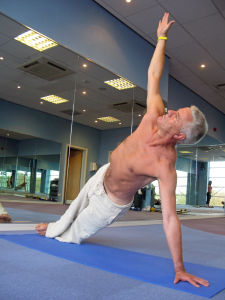
- Muscles are toned, strengthened and lengthened. Not just the obvious muscles but all muscles and some you might not know you had.
- Joints are mobilised, opened and strengthened.
- By load-bearing and gently stressing different bones, calcium uptake is encouraged and this strengthens the skeleton.
- Tiny muscles and joints in the spine are targeted, increasing mobility and strength and improving alignment and posture.
- The cardio-vascular and lymphatic systems are improved.
- The digestive system is massaged and improved.
At the end of a Yoga class you should feel relaxed yet energised. Your body should feel realigned. Your mind and body should feel rejuvenated.